
CG Wealth Management January Newsletter
Personal Note From Chris Getzlaf
To all CG Wealth Management clients, Happy New Year! I hope you had a great holiday season with friends and family and were able to take some time to rest and recharge before the new year! As of January 2nd, our office doors have reopened, and the team is excited and ready for a great 2025!
The CRA has announced that the TFSA contribution limit for 2025 is $7,000. If you haven’t already been contacted by me to contribute to your TFSA, feel free to reach out if you want to get your TFSA topped up, or have any questions about this year’s limit.
With the new year, comes new resolutions. If one of your new resolutions includes your finances, like you’re planning on retiring this year, want to create a budget that reduces your debt but also invests for the future, or want to get into a better habit of saving and investing regularly, as a CG Wealth Client, our team would be happy to work towards those types of resolutions with you.
Before getting to the bulk of the newsletter, I wanted to let you know that the office has a Facebook page where we post regular updates. So, if you haven’t already done so, click the button below and give us a follow!
To all our clients, have a great start to the new year!
-Chris Getzlaf, Partner at CG Wealth Management
What’s New
Typically, our newsletter focuses on the major events that happened the month prior, however, we would be remiss if we didn’t acknowledge that Prime Minister Justin Trudeau officially announced his intent to resign as Prime Minister and the leader of the Liberal Party on January 6, 2025. At the same time, the Prime Minister confirmed that Parliament has been prorogued (suspended) until March 24, 2025.
Of the various impacts this will have, there is a possibility that the proposed changes to the capital gains tax as announced in the 2024-25 federal budget could become void due to how the proposed changes were introduced in Parliament.
The team will continue to monitor the situation as it progresses.
As a refresher, in its 2024-2025 budget, the federal government had announced that it was increasing the Capital Gains Inclusion Rate to 66 2/3%, on all gains earned by corporations and trusts, and on gains realized by individuals annually over $250,000, effective June 25, 2024.
Market Updates
The top headlines in the financial markets that we paid attention to in December were:
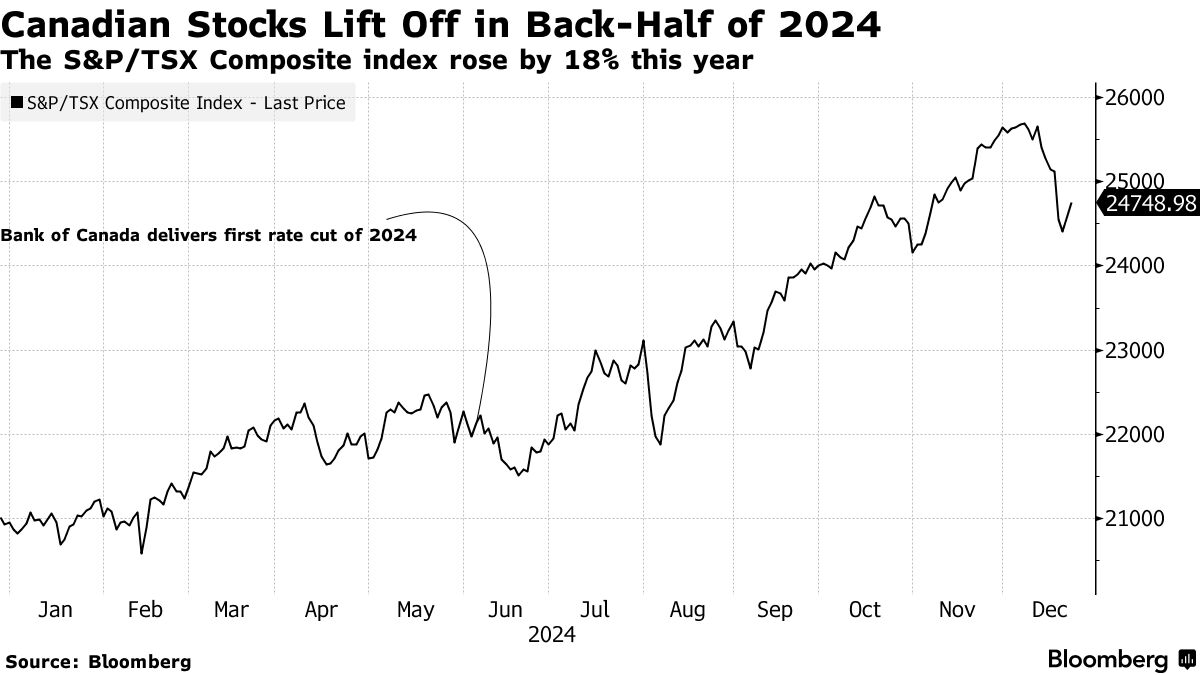
In Canada, the S&P/TSX recorded its best year since 2021, gaining over 21% in total return. After getting off to a slow start, the TSX gained speed after the Bank of Canada began its rate-cutting cycle in June.
In the U.S., the S&P 500, which set 57 record highs in 2024, finished up about 23% for the year in USD terms and more than 36% in CAD.
The tech-heavy Nasdaq was up 29% in USD.
Markets got a massive boost in 2024 from investor enthusiasm around artificial intelligence. Stocks with exposure to the AI business, such as Nvidia, saw their prices increase greatly. It remains to be seen whether those gains can be maintained in 2025.
Macroeconomic Updates
The top headlines in the broader macroeconomy that we paid attention to in December were:
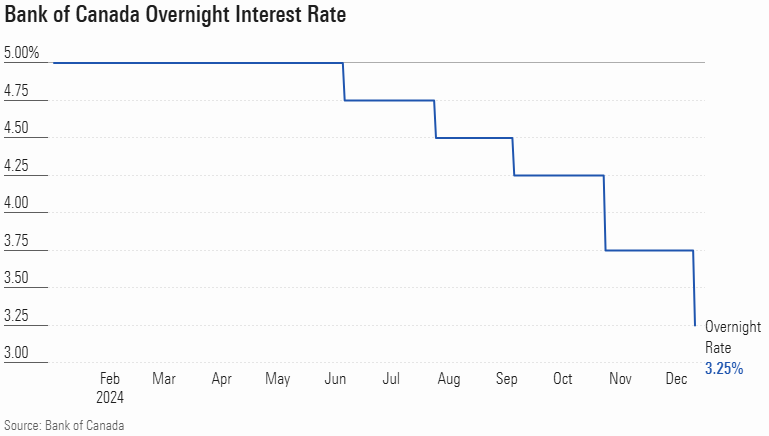
On December 11, 2024, the Bank of Canada cut the overnight rate by 0.50%, resulting in the target overnight rate being 3.25%.This was the Bank of Canada’s fifth consecutive rate cut since it’s first in June of 2024 (see chart below).
According to Statistics Canada, the most recent Consumer Price Index was 1.9% in November, down from a 2.0% increase in October. Slower price growth was broad-based, with prices for travel tours and the mortgage interest cost index contributing the most to the deceleration.
On December 16th, the Federal Government of Canada released its 2024 Fall Economic Statement, which outlines their economic plan for the year. Of the 279 page document, much attention was focused on the federal deficit ballooning to nearly $62 billion for the 2023-24 fiscal year.
A catalyst leading to the Prime Minister’s resignation announcement on January 6 was the unexpected resignation of Finance Minister, Chrystia Freeland, from her cabinet position, just hours before the release of the 2024 Fall Economic Statement. Her resignation marked the fifth cabinet Minister to step down in 2024.
Dollar Cost Averaging - Why You Should Consider Utilizing It
A regular section of this monthly newsletter that our readers can come to expect is a “Learn” section. This section is intended to provide you with practical financial information and concepts that will help you develop your learning and understanding of the world of finance.
In this edition, we will focus on Dollar Cost Averaging, which is an effective way to invest your money. Here is how it works:
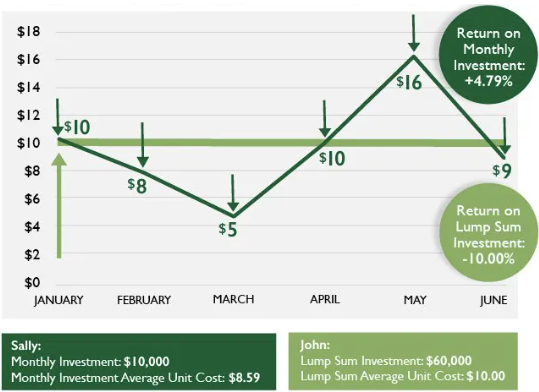
Instead of investing your money all at once, you can dollar cost average and invest smaller amounts at regular times, like weekly, bi-weekly, or monthly. This means that when the price of shares are low, you buy more shares, and when they’re high, you buy fewer. The benefit of dollar cost averaging is that it:
Provides consistency as your overall returns will reflect the general trend in the investment’s performance, rather than the specific price from one day.
Reduces risk as it protects you from significant draw downs if you were to potentially buy only at the peak of the market.
Encourages consistent saving and investing as the strategy requires you save money and invest the savings regularly.
The most effective way to start dollar cost averaging is to set up a regular contribution plan to one or more of your plans, like a TFSA, Non-Registered account, or RRSP. What many like to do is set up a contribution plan that coincides with their pay period so that a portion of their pay cheque is automatically saved and invested – out of sight, out of mind.
Remember it’s about time in the market, not timing the market!
To illustrate the benefits of dollar cost averaging, consider the example below.
If you do not already have a systematic contribution plan on one or more of your plans and want to take advantage of this effective investing strategy, please reach out to myself and I’d be happy to help you create a strategy that works for you!
