
CG Wealth Management February Newsletter
Personal Note From Chris Getzlaf
As we close out the first month of 2025, it feels like a year’s worth of news and global events have already happened – the announcement of the Prime Minister’s intended resignation, wildfires that decimated parts of southern California, the inauguration of the 47th President of the USA, and a cease-fire in the middle east are just to name a few…
With the speed which these global events seem to be occurring and their contribution to the uncertainty in the market, I believe it is the right time to speak a bit about the market volatility we have been experiencing in the last month.
If there is one thing to take away from this edition of the newsletter, it is that wealth accumulation isn’t always a smooth climb. From time to time, the market will experience some turbulence, it is inevitable.
Just take the below graph as an example. Since the turn of the millennium, 14 out of 25 years experienced drawdowns of 10% or greater, BUT only seven of those years ended in negative territory.
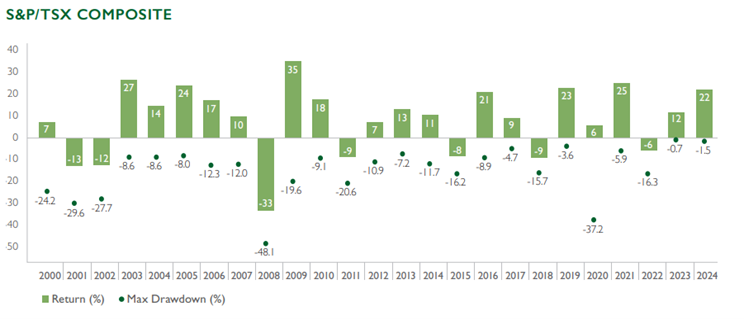
Even if we look at this past January, the S&P/TSX’s worst day was down 1.22%. Fast forward to the end of the month, and we finished the month up overall nearly 3.3%!
It’s during these times of volatility that good opportunities to invest in the market arise.
Remember, wealth accumulation takes time and isn’t always a smooth ride.
-Chris Getzlaf, Partner at CG Wealth Management
What’s New
As a valued client of CG Wealth Management, we want to remind you that we offer tax preparation, filing, and mock return services. As the 2024 tax filing season starts to ramp up, here is what you need to know and start preparing for:
1) Key dates this tax season are:
March 3, 2025: The last day to contribute to your RRSP or a Spousal RRSP and receive the tax deduction for the 2024 tax year. If you’re interested in topping up either, if eligible, please reach out to our office and Chris would be happy to work with you.
April 30, 2025: The last day to file for most individuals.
June 16, 2025: The last day to file for self-employed individuals.
2) Despite Glen Koshman’s retirement from providing financial advisement services, he will still be preparing and filing income tax returns for CG Wealth Clients.
3) We will send out communication via email next week to clients who have regularly used this service in the past, instructing on where and how to submit your tax documents.
4) If you’re reading this, have not utilized this service before, and are interested in doing so, give our office a call or send us an email and we would be happy to forward you the instructions mentioned above once they’re finalized.
5) Employers and Investment companies have:
Until the end of February to send out their investment tax slips for T4s and registered accounts (RRSP, RIF, FHSA, etc.).
Until the end of March to send out their investment tax slips for non-registered accounts.
Market Updates
The top headlines in the financial markets that we paid attention to in January were:
The S&P/TSX was up nearly 3.3% in January whereas in the U.S., the S&P 500 reported a 2.7% gain.
A tit-for-tat tariff fight among the world’s major economies adds fresh headwinds to the outlook for global growth, for profits of companies suddenly facing higher import taxes, and for financial markets adjusting to new trade flows.
Global financial markets were shaken by news of afresh artificial intelligence model from Chinese startup DeepSeek, which raised questions over America’s technological dominance and fueled concerns that high U.S. tech valuations may come under pressure. The latest AI model of DeepSeek, released last week, is widely seen as competitive with those of Open AI and Meta Platforms Inc.
Macroeconomic Updates
The top headlines in the broader macroeconomy that we paid attention to in January were:
Starting mid-to-late January, Canada and Mexico were preparing to impose retaliatory tariffs due to the U.S.’s 25% headline tariffs on both country’s various imports. In a whirlwind 72 hours, Canada and Mexico agreed to and announced enhanced border security measures. As a result, all parties agreed to delay all proposed tariffs for approximately a month, during which time further trade negotiations are set to occur.
The Federal Government announced that they will be pushing back the implementation date for their new proposed capital gains tax. The new effective date is now January 1, 2026.
On January 29, 2025, the Bank of Canada further reduced the overnight rate by 0.25%, resulting in the target overnight rate being 3.00%. This was the Bank of Canada’s sixth consecutive rate cut since June of 2024. The next interest rate decision is March 12, 2025. Below is a graph that shows Canada’s inflation rate vs interest rate.
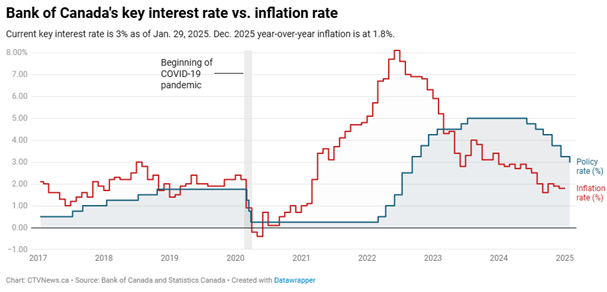
Statistics Canada reported on January 21st that the national annual inflation rate was 1.8% in December. The month over month decrease was partly attributed to the federal government’s temporary GST/HST tax break.
Donald Trump was inaugurated as the 47th President of the United States of America on January 20, 2025.
A total of six Liberal leadership contenders have emerged since the Prime Ministers resignation announcement. The two individuals who appear to be leading the Leadership race currently are former central banker Mark Carney, and former Finance Minister and current MP, Chrystia Freeland.
What is a Tariff? What is all the Fuss About?
As the talk of tariffs and a potential tariff war flooded the news cycle in January, we thought it would be good to give a quick briefer for everything tariffs.
What is a tariff?
A tariff is a tax put on an imported good(s) by a government.
How do they work?
When a tariff is applied on an imported good, businesses who import that good must pay the price of the good plus the new tax(tariff) to the government.
Typically, that business who imports that good will then raise their prices so that their new costs are covered, essentially passing the majority of the burden onto the consumer.
Why use tariffs?
Tariffs are meant to make foreign imported goods more expensive, incentivizing you to buy that same good from a local business.
Who do tariffs Impact?
Broadly speaking, tariffs affect:
You: The increase in cost of the good maybe passed onto you by the business as they may increase their prices.
Local Businesses: Local businesses who make the same tariffed good for the same price or cheaper may benefit as consumers will opt to buy something that is cheaper and local.
Foreign Government & Businesses: Foreign businesses and governments may be hurt or benefit financially from tariffs depending on the amount of goods imported/exported.
In conclusion, tariffs can be a doubled edged sword. While they can increase costs for you, the consumer, they can also protect and support local businesses and economies.
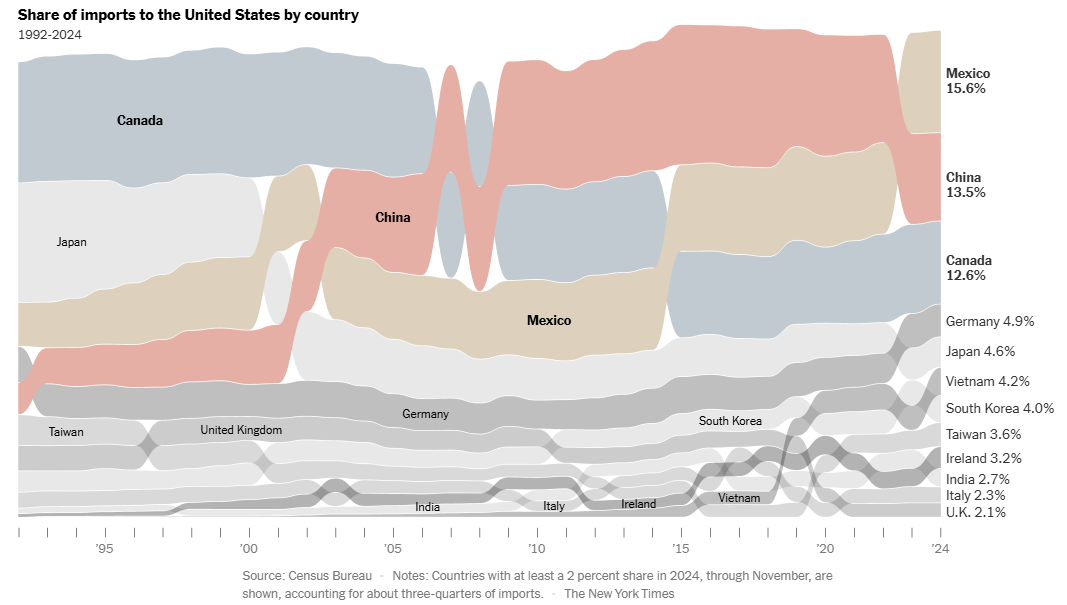
If you have questions about how tariffs are affecting your portfolio or how you can mitigate tariff risk. Please reach out, we would be happy to further discuss!
