
CG Wealth Management April Newsletter
Personal Note From Chris Getzlaf
As we are close out on the first quarter of the year, a reminder that (for most) taxes are to be submitted to the CRA by April 30. For those who are waiting to receive your tax slips for your non-registered accounts, investment companies had until the end of March to send them out. For those who are interested in having your tax return completed by Glen Koshman, as noted in the last several editions of this newsletter, please let me know and the team will be happy to send you instructions on when and where to submit your income tax information.
Turning to the elephant in the room, I want to speak again on the volatility that we are currently experiencing in the market. For those who may not have saw, we had sent out communication earlier this week in response to the market sell-off we saw on Monday. Since then, the market has rallied, sold off, rallied again, and now has had some selling off. My message remains the same, stay patient and we will weather the storm. In times of turmoil, it may be easy to have a knee jerk reaction. I want to challenge those of you who may be feeling uneasy about the volatility we are all experiencing is to try switch to a more longer-term focus. Having a longer-term focus can aide in handling the potential bumpy road to wealth creation.
For those who are invested in our CG Wealth Portfolios, we are actively speaking to our fund managers whose products are apart of our portfolios so that we are up to date on any changes they’re making. In addition to that, we have taken proactive measures to try and help protect against downside risk in the market through diversification. When the portfolios were built, diversification was one of the cornerstones. Diversification in not only the types of equities (stocks) you’re invested in, where the companies operate geographically, the sectors and industries they’re apart of, but also the weightings of asset classes you’re invested in, like equities and fixed income. Building in diversification from the get-go can allow our portfolios to capture the upside in one equity or asset class, when another other is down, thus reducing the overall loss to the portfolio.
Diversification in investing is one piece of the puzzle. Also remember that it’s about time in the market, not timing the market. When prices in the market are beginning to compress, a natural response can be to sell out of fear because prices could be compressed further. The issue with that mindset is that you could miss out on potential gains. To help further illustrate this point see the chart below.
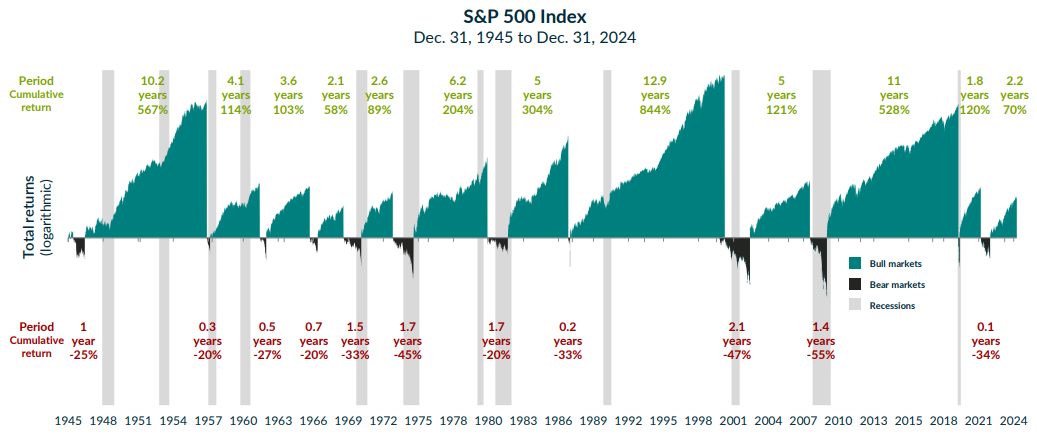
The chart above shows the performance and length of the S&P 500 Index (one of the major US stock indices) through its bull and bear markets. Although past performance isn’t indicative of future results, looking at historical markets helps illustrate the benefits of investing for the long-term. The average bull market period lasted 5.9 years with an average cumulative total return of 277%. The average bear market period lasted one year with an average cumulative loss of-32%. The S&P has been in a bull market about 86% of the time.
In closing, if after reading all of this and you’re still feeling uneasy about the state of the market, you can always reach out chat with myself. Just give me a call and I would be happy to chat through any concerns you may have.
Enjoy this month’s edition of our newsletter and be sure to take advantage of the sunnier weather that April should bring!
-Chris Getzlaf, Partner at CG Wealth Management
What’s New
When this month’s newsletter was being drafted, various monumental global events, primarily regarding the international trade war, occurred in a short amount of time. As of yesterday (April 9), the US administration has announced that there will be a 90 day pause on all the reciprocal tariffs that were initially announced on April 2, 2025, aka Liberation Day, for most countries. The US government cites that a reason for this 90-day pause is that over 70 countries and counting have indicated their willingness to negotiate new international trade deals with the States. During this 90 day pause, only a 10% import tariff will be applied. At this time, it is unclear which countries will receive this pause/reduction in reciprocal tariffs. Additionally, the US Administration announced that import tariffs on Chinese goods will increase to 125% because of China’s retaliatory 84% tariff increase on US goods– up from 34% initially, beginning today (April 10).
Shifting the focus back to Canada, the CRA has announced that the new effective date for the increase to the Capital Gains inclusion rate is January 1, 2026. With this new effective date, the inclusion rate on capital gains in excess of $250,000 for individuals and all capital gains realized by corporations will increase from 50% to 66%.Therefore, if any of our clients are thinking about taking on a larger capital gain as described previously, give the office a call to chat with Chris to talk potential strategies that you might want to consider.
Market Updates
The top headlines in the market in March were:
Equity markets globally were down in March. In Canada, the S&P/TSX was down over -5% and in the States, the S&P 500 was down over -6%. Looking to broader international markets, like Asia, the Nikkei 225 was down a little over -4%. The pullbacks we saw in March were in relation to the uncertainty for investors as April 2, the date that the USA planned to announce global reciprocal tariffs against various countries, neared.
Due to the uncertainty flooding the markets near the end of March, gold reached a record high spot price of over $3,100 USD per ounce. Historically, gold has been known as a “safe haven” for investors and can increase in price during times of volatility.
Numerous mega-giant giant companies have announced major investment plans into the US over the next several years:
Apple announced a $500 billion investment in the US over the next four years.
Nvidia and TSMC, two of the world leaders in chip manufacturing that supports artificial intelligence plan to invest hundreds of billions of dollars in the US over the next four years.
Johnson& Johnson announced their plan to increase US investment to more than $55 billion over the next four years
Macroeconomic Updates
The top headlines in the macroeconomic sphere in March were:
The Bank of Canada further reduced the interest rate by 0.25% to 2.75%, the lowest level since September 2022. This marks the seventh consecutive cut in interest rates in Canada. The next rate decision is on April 16
In March, Statistics Canada released February’s inflation numbers. In Canada, inflation grew at the fastest pace in eight months as the Consumer Price Index rose at a 2.6% yearly pace, the highest rate since June and up from 1.9% in January.
Despite the whirl wind tariff talk that has flooded the news since the beginning of April, as a recap, these were the top tariff headlines in March.
China placed a 100% import tariff on Canadian Canola, as well as other agri-food products, in response to the Canadian Federal Government’s 100% import tariff on Chinese-made electric vehicles.
On March 4,US tariffs of 25 per cent on Canadian goods and 10 per cent on energy and potash exports from Canada came into effect.
On March 12, the US imposed tariffs of 25% per cent on Canadian steel and aluminum products
Mark Carney won the Liberal Leadership race on March 9, as he secured more than 85% of the Liberal Party’s vote. Nearly a week later, on March 14, Justin Trudeau officially resigned as Prime Minister of Canada and Mark Carney was sworn into office. Carney’s most notable actions taken as the new Prime Minister thus far have been:
Called a federal election to occur on April 28, 2025.
Reduced the consumer carbon tax to $0. Despite the Prime Ministers reduction in the carbon tax, he has not scrapped the underlying legislation that enabled the Federal government to levy the tax in the first place. This means that, in theory, that the consumer carbon tax could be increased in the future.
The Saskatchewan Provincial Government tabled the 2025-26 provincial budget on March 19. Some highlights from the budget include:
Taxation changes provide over $250 million in tax savings this year for Saskatchewan residents ,in addition to the more than $2 billion in affordability measures in every budget.
Funding to operate Saskatchewan kindergarten to grade 12 schools will increase by $186 million, or8.4 per cent, for a total of $2.4 billion for the 2025-26 school year.
Provincial health care funding will increase by $485 million, or 6.4 per cent, over the previous year for a record total $8.1 billion for the year.
Please don't hesitate to contact us if you have any questions. The team is looking forward to helping you plan to prosper.
